ALL Electric
In the full review (17 sections)
- Should you buy one?
- Quick specs
- Who it’s for
- Who should look elsewhere
- Obsidian vs Aventure 3 vs Aventure M vs Ramblas ADV
- Unboxing and assembly
- The controls
- Suspension and comfort
- Motor, speed and the class question
- Battery and range
- What the specs mean on the road
- The inverter
- The gripes
- Pros and cons
- FAQ
- Price
- Related reviews and guides
Should you buy one?
Buy the Obsidian if you want a full-suspension fat tire bike with a big battery, a throttle and a torque sensor (Mokwheel lists a combined torque and cadence sensor), and you like the idea of using the bike’s battery to power gear at a campsite. Suspension at both ends makes it very comfortable.
Skip it if you need a light bike, a phone app or an integrated tail light. Mokwheel lists it at 77 lbs, the display doesn’t connect to a phone, and there’s no tail light out of the box.
The deciding factors: comfort and battery size against weight. With 940Wh, 105Nm and full suspension, the Obsidian gives you a lot for the price, as long as you can store and move a 77 lb bike.
Check the Obsidian at Mokwheel (affiliate link). Use code WILL30 for $30 off.
A note on this review: it’s my initial review. I unboxed and built the bike the same day I filmed, so it covers setup, controls, specs and the inverter, not a long-term test.
Quick specs
From Mokwheel’s Obsidian page, checked Oct 22, 2026.
| Spec | Mokwheel Obsidian |
|---|---|
| Motor, rated (W) | 750 |
| Motor, continuous (W) | 1,000 |
| Motor, peak (W) | 1,300 |
| Torque (Nm) | 105 |
| Battery (V) | 48 |
| Battery (Ah) | 19.6 |
| Battery (Wh) | 940 |
| Range (mi) | 60-80 |
| Top speed, throttle (mph) | 20 |
| Top speed, pedal assist (mph) | 28 |
| Fork travel (mm) | 130 |
| Rear gears | 8 |
| Tires (in) | 26 x 4 |
| Weight (lbs) | 77 |
| Payload (lbs) | 560 |
| Charger (A) | 3 |
| Rider height (in) | 66-80 |
| Price as of Oct 22, 2026 (USD) | 1,799.99 |
Mokwheel lists an IPX7 rating for the battery and IPX6 for the whole bike.
Who it’s for
- Riders who want a soft ride on gravel, dirt and broken pavement. Dual suspension made it really comfortable for me.
- Campers and overlanders. Mokwheel’s inverter turns the bike battery into a power source for a laptop, phone or camera gear.
- People who want a throttle and also a torque sensor. The throttle works from zero, and I called the torque sensor a huge upgrade over cadence sensors.
- Taller riders. Mokwheel lists rider heights from 5’6” to 6’8”.
Who should look elsewhere
- If you ride steep, technical trails and want a lighter bike that climbs better, look at the mid-drive Aventon Ramblas.
- If you want app connectivity and integrated lights front and back, the Aventon Aventure 3 has both.
- If you’re under about 5’6”, check Mokwheel’s sizing before you order.
Obsidian vs Aventure 3 vs Aventure M vs Ramblas ADV
Every figure here comes from the current manufacturer pages.
| Mokwheel Obsidian | Aventon Aventure 3 | Aventon Aventure M | Aventon Ramblas ADV | |
|---|---|---|---|---|
| Rated motor power (W) | 750 | 750 | 250 | 250 |
| Peak motor power (W) | 1300 | 1440 | 750 | 750 |
| Torque (Nm) | 105 | 80 | 100 | 100 |
| Battery (Wh) | 940 | 733 | 733 | 708 |
| Rated range (mi) | 80 | 65 | 85 | 90 |
| Weight (lbs) | 77 | 76 | 73 | 54 |
| Fork travel (mm) | 130 | 80 | 80 | Not listed |
| Rear suspension | Yes | No | No | No |
| Throttle | Yes | Yes | No | No |
| Tire width (in) | 4.0 | 4.0 | 4.0 | 2.4 |
| Rear gears | 8 | Not listed | 10 | 12 |
| Price, USD (as of Oct 22, 2026) | 1,799.99 | 1,999 | 2,899 | 2,899 |
The Aventure 3’s 1440W figure is Aventon’s Boost Mode number. For the trail-bike matchup, see Mokwheel Obsidian vs Aventon Ramblas. For the Aventon fat tire bikes against each other, see Aventure 3 vs Aventure M.
Unboxing and assembly
Assembly isn’t bad. Two things to know: there are a few extra small bolts in the box, so don’t panic if some are left over. And the two fenders aren’t interchangeable. The longer one goes on the back.
The controls
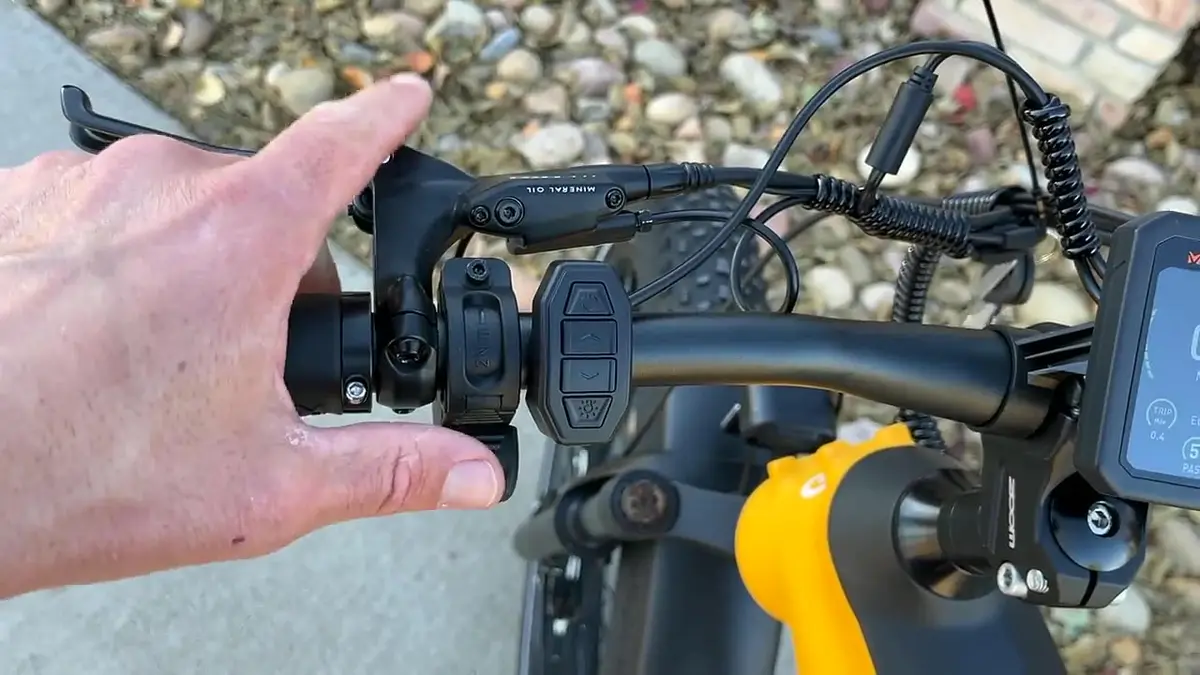
The grips have a gel feel and are comfortable to rest your hands on. The brakes are hydraulic discs. Mokwheel lists Tektro TKD171s. The throttle works from zero, and there’s a horn hidden underneath the control pod, along with the power button and the up and down buttons for pedal assist.
The throttle won’t work in pedal assist level 0. That’s a safety feature. If you’re used to bikes that let you throttle with assist off, it will surprise you the first time.
Under the pedal assist buttons there’s a light button that turns on the headlight, with an indicator on the display.
The full color display is easy to read and the interface is nice. It shows your speed with a red line marker. It doesn’t connect to your phone, so there’s no app, ride logging or GPS.
The shifter is the best part of the cockpit. It’s a thumb and index finger design, easy to use and the cleanest of all the shifters I’d tested at that point. It runs one chainring in front and eight gears in back.
Suspension and comfort
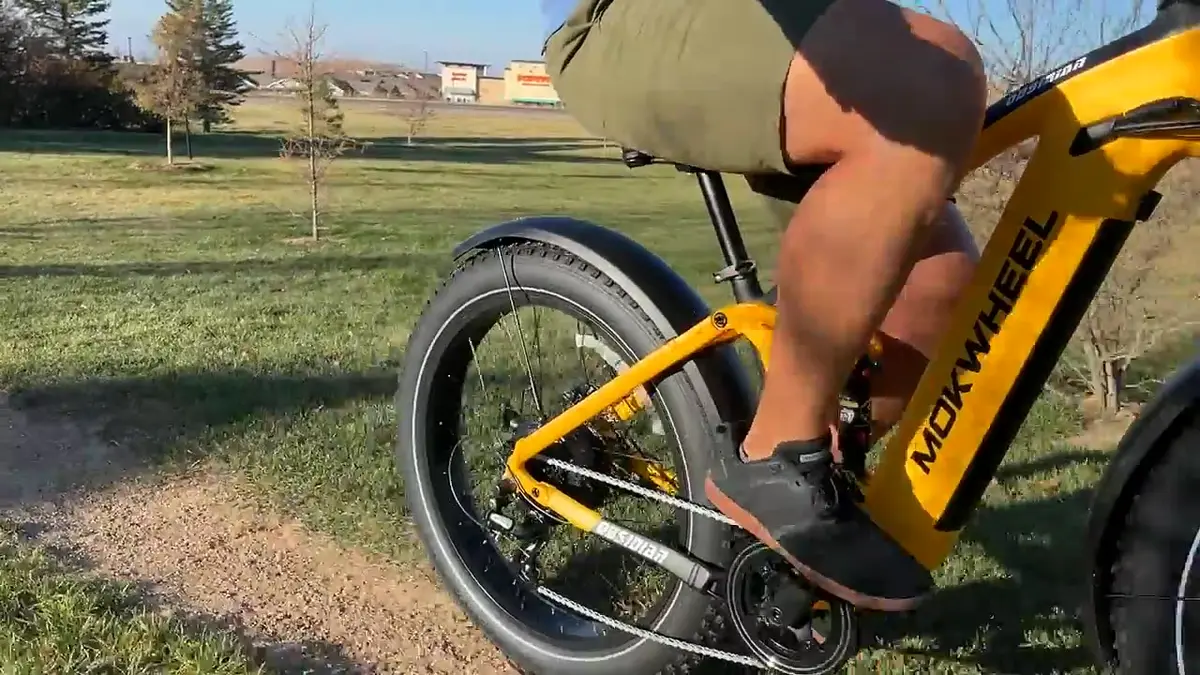
Dual suspension is what sets the Obsidian apart. There’s a fork up front, which Mokwheel lists at 130mm and adjustable, and a rear shock. Combined with 26 x 4.0 puncture-resistant fat tires, it’s a very comfortable ride.
A viewer asked about the front shocks. They’re not top of the line, but they get the job done in most cases.
The seat is wide but fairly rigid. If you ride long distances, budget for a softer saddle.
Motor, speed and the class question
The motor is a rear hub. In the video I called it a 1000 watt motor. Mokwheel’s page lists it as 750W rated, 1000W continuous, 1300W peak and 105Nm+ of torque. Mine shipped capped at 20 mph, as a Class 2 bike.
Mokwheel also lists 28 mph on pedal assist (level 5 in my video) and 20 mph on the throttle, and calls the bike Class 2/3. Out of the box, expect 20 mph; 28 mph on pedal assist has to be unlocked. When a commenter asked how, I said it’s just a software setting, but I’m not sure exactly how to change it. Before you do, check whether Class 3 is allowed where you ride. The e-bike laws by state guide is a good place to start.
Mokwheel lists a torque plus cadence sensor. In the video I called the torque sensor a huge upgrade over cadence sensors. The motor responds to how hard you push, not just whether the pedals are turning.
Battery and range
The battery uses Samsung cells: 48V and 19.6Ah, which works out to 940Wh. It’s removable with a key, and you can charge it on or off the bike. Mokwheel rates the range at 60 to 80 miles. Rider weight, towing a trailer, temperature and terrain all pull that number down.
What the specs mean on the road
Torque plus cadence sensor. The torque side scales help to how hard you push, which is why I called it a huge upgrade over cadence-only bikes.
105 Nm and 1,000W continuous. That’s a lot of pull for a hub motor.
940Wh battery. That’s about 30% more than the 733Wh Aventon fat tire bikes in the table above. A bigger battery gives you more range, or the same range at higher assist. It’s also what makes the inverter useful, since you’re running gear off that same battery.
130mm fork plus rear shock. Both ends move, which is why it rode so comfortably.
560 lb payload. That includes you and anything you carry or tow. It’s a high number, and it leaves room for a heavy rider plus camping gear.
77 lbs. That’s heavy. You need a strong car rack, and stairs will be hard.
3A charger. That’s a standard charger, not a fast one. A big 940Wh battery takes a long time to fill at 3A. Mokwheel doesn’t list a charge time.
The inverter
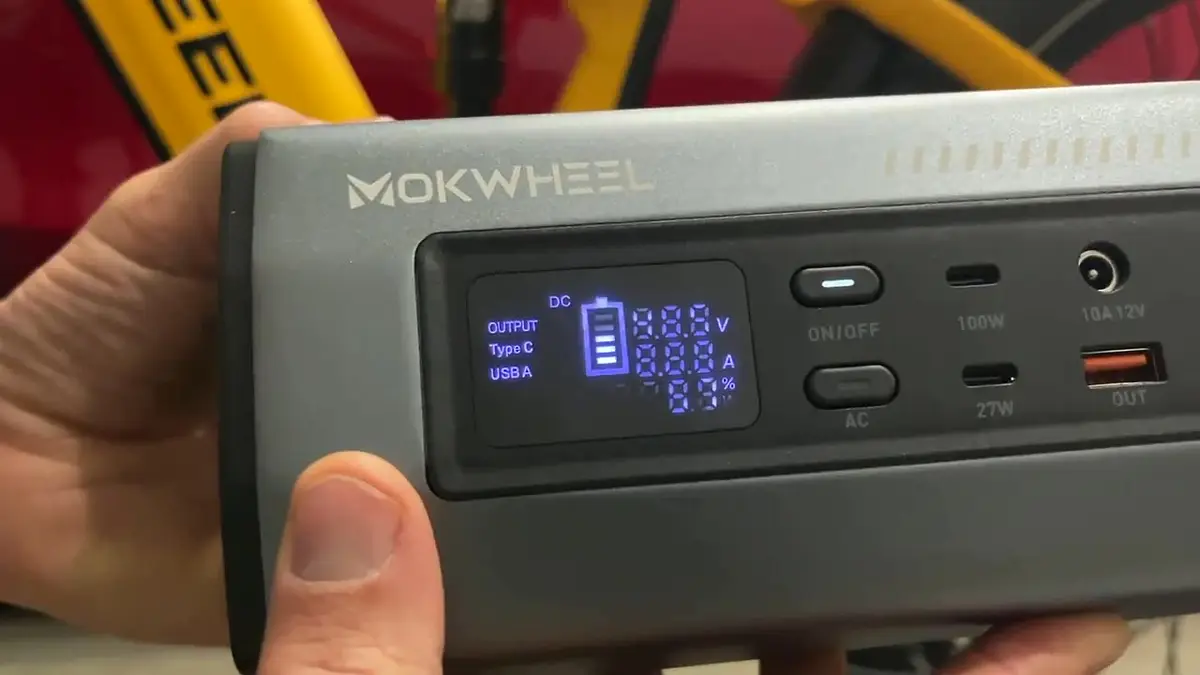
This was the most unusual feature I’d seen at the time. Mokwheel sells an inverter that plugs into the bike and turns its battery into a power source. It has a 12V plug, USB and USB-C outputs, and Mokwheel also offers a solar kit.
The inverter comes with a manual, a mounting bracket and a semi-hard zip case. You could mount it on the bike, but it would probably have to go up front where it might get in the way, so a bag may work better. A separate cord runs from a covered port on the bike to the inverter. Hold the AC button to turn on its two AC outlets, and it shows a constant readout of how many watts you’re using.
I tested it by charging a large Toro battery, and the inverter pulled about 116 to 117 watts. The fan is a little loud. With the inverter on the ground and you at a table a few feet away, it wouldn’t bother you. The idea is that you ride out to a campsite and run a laptop or charge camera batteries from the bike.
The gripes
- No integrated tail light. A commenter asked why. My understanding is it’s because the Obsidian doesn’t come with a rear rack to mount one on. Add a clip-on light before riding at dusk.
- No phone connection.
- At 77 lbs, it’s heavy to lift onto a car rack or carry up steps.
- Throttle doesn’t work in PAS 0, which you may or may not like.
Pros and cons
Pros
- Full suspension with a 130mm adjustable fork
- 940Wh Samsung-cell battery, removable with a key
- Torque sensor plus a throttle that works from zero
- Best shifter of the bikes I’d tested at that point
- Inverter and solar options for camping
- 560 lb payload rating
Cons
- No integrated tail light
- No app or phone connection
- 77 lbs
- Ships at 20 mph; the 28 mph setting needs unlocking, and I’m not sure how
- Seat is rigid
FAQ
Mokwheel Obsidian vs Aventon Aventure: which should I get?
The Obsidian has full suspension, a bigger 940Wh battery and more torque on paper. The Aventure 3 has an app, built-in lights front and back, and turn signals. Pick the Obsidian for comfort and range, and the Aventure 3 for features. My Aventure 3 review covers that bike in depth.
Mokwheel Obsidian vs Aventon Ramblas?
The Ramblas is a Class 1 mid-drive hardtail with no throttle, built for climbing technical trails. The Obsidian is a heavier full-suspension fat tire bike with a throttle. The comparison goes deeper.
Is the Obsidian full suspension?
Yes. It has a front fork and a rear shock.
Can it go 28 mph?
Mokwheel lists 28 mph on pedal assist, but mine shipped capped at 20 mph as a Class 2 bike. Unlocking it is a software setting, and I’m not sure of the exact steps.
Is there a Mokwheel Obsidian discount code?
Yes. Code WILL30 takes $30 off at Mokwheel.
Is it a mid-drive?
No. It’s a rear hub motor.
Is it the best full-suspension fat tire bike under $2,500?
At $1,799.99 as of Oct 22, 2026, it’s well under that budget. It’s also the only full-suspension fat tire bike in this comparison.
Price
When I filmed, Mokwheel was running a Black Friday price of $2,299, $600 off the regular $2,899, plus a $99 accessory pack. That sale is long over. As of Oct 22, 2026, Mokwheel lists the Obsidian at $1,799.99 (compare-at $2,199.99), and one variant is $1,899.99. Code WILL30 takes another $30 off.
The $99 Black Friday pack in my video included a bike cover, trunk bag, folding lock, front basket, helmet, padded saddle, phone mount, mirror, suspension seat post and water bottle. I also said the website was including front and rear fenders and a trailer at the time. Check what’s included today, since that offer is over.
Check the Obsidian price at Mokwheel (affiliate link; code WILL30 for $30 off).