 ALL Electric
The AEB Score, short for ALL Electric Bikes Score, is a number from 0 to 10 that I give every e-bike I've reviewed, based only on its published specs and the price I reviewed it at. It's there so you can compare bikes apples to apples, at a glance, across brands and years. It is not my opinion of the bike. That lives in each review.
On this page
Why it exists
I've been testing electric bikes on my channel since 2015. Over that time I've reviewed dozens of bikes, from 36 lb commuters to 88 lb cargo bikes, and I get the same question over and over: "Which one is better?" The honest answer is that it depends on how you ride. But it's still useful to see, side by side, which bikes give you more battery, more motor, better brakes and more capacity for the money.
The trouble with comparing spec sheets by hand is that every brand lists things differently. One gives peak watts, another rated watts. One lists torque, another doesn't. Some give battery size in watt-hours, others in volts and amp-hours. The score puts all of that on the same scale, using the same rules for every bike, so you don't have to.
It's also deliberately simple. Every input is a number you can check on the bike's review page, and every rule is written out below. If you disagree with how I weight things, you can see exactly how the result would change.
The five categories
Each bike gets a 0 to 10 score in five categories. The overall score is a weighted average of those five. Here's what each one measures, how much it counts and why.
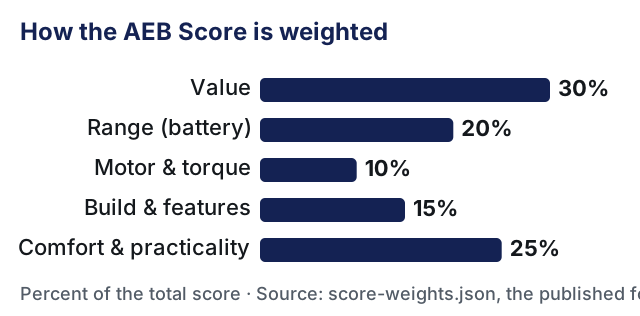
Value (30%)
Value asks: how much bike do you get for the money? I take the average of the range, motor and build scores, multiply by $1,500, and divide by the price I reviewed the bike at, capped at 10. A bike with average specs at $1,500 scores about the same on value as on specs. The same specs at $1,000 score higher; at $3,000, lower. It's weighted highest because price is the first filter for most people who email me, and specs only matter relative to what you pay. In plain terms, the rule is: average of the range, motor and build scores, times $1,500 divided by the price I reviewed it at, capped at 10.
I use the price at review time because that's the price I had in front of me when I tested it. Prices change a lot, and some bikes are discontinued. If I can't confirm a US price, or the listed price is for a different model, value is left blank.
Range, by battery size (20%)
Range is scored from battery capacity in watt-hours, not the maker's range claim. Range claims are measured in very different ways, and in my testing they're often far above what a 200 lb rider gets. Battery capacity is the one number that's measured the same way everywhere. The scale: battery size in Wh: 300 Wh or less = 3, 1,000 Wh or more = 10, straight line between. When a brand only lists volts and amp-hours, I multiply them to get watt-hours.
Motor and torque (10%)
This is the average of the motor's rated watts and its torque in newton-meters, using whichever the maker lists: average of rated watts (250 W = 3, 1,000 W = 10) and torque (40 Nm = 3, 105 Nm = 10), using whichever the maker lists. I use rated (sustained) watts instead of peak because peak numbers aren't measured consistently. Torque is what you feel starting from a stop and climbing, which is why it's half of this category. It's weighted lowest because almost every bike I test is capped at 750 W, and past that, extra power matters less day to day than price, weight and build. My hills guide explains why.
Build and features (15%)
This averages three things that matter for safety and durability: brakes, suspension and maximum load. The scale: average of brakes (hydraulic 10, mechanical or rim 5), suspension (none 3, front fork or seatpost 7.2, front and rear 10) and max load (220 lb = 3, 440 lb = 10), using whichever are listed. Hydraulic disc brakes stop more consistently with less hand effort. Suspension makes rough roads and trails more comfortable. A higher listed max load means the frame, wheels and brakes were designed for more weight, which helps heavier riders and anyone carrying cargo.
Comfort and practicality (25%)
This one is just bike weight, because weight affects everything about living with a bike: lifting it onto a car rack, carrying it upstairs, rolling it into a garage, and pedaling it with the power off. The scale: bike weight, lighter is easier to live with, so extra weight counts against a bike: 36 lb = 10, 88 lb = 3. It's the second-biggest weight, because a lighter bike is easier to own every day. Extra pounds count against a bike here, even when they come from a bigger battery or stronger frame; those already earn credit under range and build.
One more rule applies to every scale: The lowest spec in each scale earns 3, not 0, so a basic spec is never scored the same as a missing one.
A worked example: Velotric Discover 1
Here's the whole calculation for one real bike, the Velotric Discover 1, using the specs on its review page.
| Category | Inputs | Score | Weight | Points |
|---|---|---|---|---|
| Range | 692 Wh | 6.9 | 20% | 1.38 |
| Motor & torque | 500 W (5.3), 65 Nm (5.7) | 5.5 | 10% | 0.55 |
| Build & features | Hydraulic (10), front fork (7.2), 440 lb (10) | 9.1 | 15% | 1.36 |
| Comfort | 63.5 lb | 6.3 | 25% | 1.57 |
| Value | Specs avg 7.2 × $1,500 ÷ $1,300 | 8.3 | 30% | 2.49 |
| Total | 100% | 7.4 |
Step by step: the 692 Wh battery is 392 Wh above the 300 Wh starting point, out of a 700 Wh span, so it sits 56% of the way up the 3 to 10 scale, which works out to 6.9. The 500 W motor is a third of the way from 250 W to 1,000 W (5.3), and 65 Nm is 38% of the way from 40 to 105 Nm (5.7), so motor averages 5.5. Hydraulic brakes, a front fork and a 440 lb load average 9.1 for build. At 63.5 lb it sits about halfway between 36 and 88 lb, for a comfort score of 6.3. Its three spec scores average 7.2, and at $1,300 that's multiplied by 1,500 ÷ 1,300 for a value of 8.3. Weight each and add them up: 7.4.
What the number doesn't tell you is that it fit both me at 6'1" and my wife at 5'6" with only a seat adjustment, or that the rear rack costs extra. That's what the review is for.
What the score does not measure
The score only knows what's on a spec sheet. It doesn't know:
- How a bike rides. Handling, ride feel, how natural the pedal assist feels, how quiet the motor is.
- Real-world range. It uses battery size, not my range test results.
- Fit. Whether you'll be comfortable at your height. At 6'1" I couldn't pedal the Actbest Super X comfortably because its seat is fixed, but its specs look strong on paper.
- Build quality and reliability. Welds, finish, how parts hold up over months.
- Hills in practice. The 250 W mid-drive on the Aventon Ramblas climbs better than most 750 W hub bikes I've ridden, but its watt rating pulls its motor score down.
- Support, warranty and availability.
All of that is in my written reviews and videos. Use the score to narrow a list, then read the reviews to choose.
You should also know the score's built-in lean: it favors bikes that give a lot of battery and build for the money while staying manageable to lift. Raw motor power counts for only 10%. Very heavy cargo and fat tire bikes lose points for weight, even when that weight is useful for hauling. If you need to carry kids or cargo, my cargo guide is a better place to start.
Missing data and how often scores update
Not every brand lists every spec. When a category is missing, I don't guess or fill it with an average. I drop that category and spread its weight across the categories the bike does have, so the score is still a fair weighted average of what's known. A bike has to have at least 4 of the 5 categories to get a score at all, and it must have a confirmed price, because value is the biggest part of the score. Without either, it shows Not scored yet and isn't ranked.
The same goes for parts of a category. If a maker lists watts but not torque, the motor score uses watts alone. If brakes are listed but not suspension, build uses brakes and load.
I also leave out numbers I don't trust. If the listed price is for a newer successor model, or only a Canadian price is available, value is left blank. When a brand's own pages disagree, I use the review's listed figure and say so in that review.
Scores are recalculated from the bike data every time the site is built. If I correct a spec, add a review or change a price, every affected score updates in the next build. If I ever change the weights or scales, I'll update this page.
Every scored bike
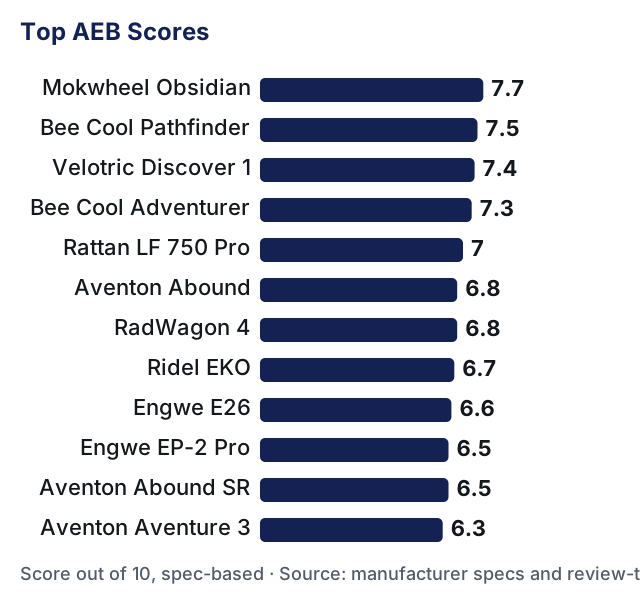
Bikes tagged Spec profile are ones I haven't ridden yet. They get the same formula from the maker's specs and price, so their score is spec-based only, with nothing from a test ride behind it. In the chart they're marked "(spec)".
Tap a column heading to sort. "—" means that category wasn't available, so its weight was spread across the others. You can also sort all reviews by score or put bikes side by side on the compare page.
| Heybike Ranger S 2.0 Spec profile | 8.6 spec-based | 10.0 | 6.9 | 7.5 | 8.6 | — |
| Ride1Up Portola 02 Spec profile | 8.3 spec-based | 10.0 | — | 8.0 | 8.0 | 6.6 |
| Ride1Up Vorsa Spec profile | 8.1 spec-based | 9.3 | — | 8.3 | 9.1 | 6.1 |
| Mokwheel Obsidian | 7.7 | 7.8 | 9.4 | 8.8 | 10.0 | 4.5 |
| Bee Cool Pathfinder | 7.5 | 6.4 | 9.6 | 8.1 | 6.4 | — |
| Velotric Discover 1 Step-Through | 7.4 | 8.3 | 6.9 | 5.5 | 9.1 | 6.3 |
| Lectric XPedition2 Spec profile | 7.4 spec-based | 8.2 | 6.2 | 7.8 | 9.1 | 6.1 |
| Velotric Fold 1 Spec profile | 7.4 spec-based | 8.5 | 6.1 | 6.9 | 9.1 | 6.4 |
| Bee Cool Adventurer | 7.3 | 7.5 | 10.0 | 8.1 | 7.4 | 4.3 |
| Lectric XP Lite2 Spec profile | 7.3 spec-based | 7.9 | — | 3.2 | 7.3 | 8.2 |
| Velotric Summit 1 Spec profile | 7.3 spec-based | 7.1 | 7.1 | 8.0 | 9.1 | 6.5 |
| Jasion EB5 Roamer ST Spec profile | 7.3 spec-based | 10.0 | 5.3 | 7.6 | 6.2 | 6.1 |
| Lectric XPeak2 Spec profile | 7.2 spec-based | 7.6 | 7.2 | 7.8 | 7.9 | 6.2 |
| Ride1Up 700 Series Spec profile | 7.1 spec-based | 7.0 | 7.2 | 7.7 | 7.6 | 6.5 |
| Rattan LF 750 Pro | 7.0 | 8.1 | 6.2 | 7.7 | 6.4 | 6.2 |
| Lectric XP4 Spec profile | 7.0 spec-based | 8.9 | 5.0 | 5.0 | 7.9 | 6.6 |
| Aventon Abound | 6.8 | 5.3 | 7.2 | 7.7 | 8.6 | — |
| Rad Power Bikes RadWagon 4 | 6.8 | 8.3 | 6.7 | 7.7 | 7.1 | 4.5 |
| Aventon Pace 4 Step-Through Spec profile | 6.8 spec-based | 6.3 | 7.3 | 5.2 | 7.6 | 7.0 |
| Ridel EKO | 6.7 | 8.2 | 4.2 | 3.0 | 4.3 | 9.7 |
| Engwe E26 | 6.6 | 6.7 | 7.7 | 8.1 | 6.8 | 4.9 |
| Velotric Nomad 2 Spec profile | 6.6 spec-based | 6.0 | 7.1 | 8.0 | 9.1 | 4.8 |
| Engwe EP-2 Pro | 6.5 | 7.0 | 6.2 | 7.7 | 5.8 | 6.0 |
| Aventon Abound SR | 6.5 | 6.3 | 7.3 | 7.7 | 9.1 | 4.1 |
| Rad Radster Trail Spec profile | 6.5 spec-based | 6.0 | 7.2 | 8.6 | 8.3 | 4.4 |
| Rad Radster Road Spec profile | 6.4 spec-based | 5.9 | 7.2 | 8.6 | 7.8 | 4.8 |
| Aventon Level 4 REC Spec profile | 6.4 spec-based | 5.6 | 7.3 | 7.5 | 7.6 | 5.6 |
| Aventon Current ADV Spec profile | 6.4 spec-based | 3.1 | 8.0 | 8.8 | 7.6 | 7.3 |
| Aventon Aventure 3 | 6.3 | 6.0 | — | 7.5 | 8.6 | 4.6 |
| Rad RadExpand 5 Plus Spec profile | 6.2 spec-based | 5.7 | 7.2 | 6.6 | 7.7 | 5.1 |
| Lectric XP Trike2 Spec profile | 6.2 spec-based | 6.9 | 6.2 | 5.5 | 8.8 | 4.2 |
| Aventon Abound LR | 6.1 | 6.0 | 7.3 | 7.5 | 9.1 | 3.0 |
| Aventon Aventure (1st gen) | 6.0 | 5.6 | — | 7.7 | 7.2 | 5.0 |
| Aventon Level 3 | 6.0 | 5.4 | 7.3 | 5.2 | 5.9 | 5.8 |
| Rad RadRunner Max Spec profile | 6.0 spec-based | 5.1 | 6.7 | 8.0 | 8.9 | 3.8 |
| Aventon Level.2 | 5.9 | 4.7 | 6.7 | 5.3 | 6.4 | 6.5 |
| Aventon Aventure M | 5.8 | 3.8 | 7.3 | 6.2 | 8.6 | 5.0 |
| Velotric T1 ST | 5.7 | 4.7 | 3.5 | 3.7 | 4.8 | 10.0 |
| MACFOX X7 | 5.7 | 6.2 | 6.2 | 5.3 | 8.2 | 3.1 |
| Aventon Soltera (1st gen) | 5.6 | 5.0 | 3.6 | 3.9 | 4.5 | 9.3 |
| Aventon Soltera 3 ADV | 5.5 | 4.0 | 3.7 | 3.0 | 5.3 | 9.9 |
| Rad RadRunner 3 Plus | 5.4 | 3.7 | 6.7 | 7.7 | 6.4 | 4.7 |
| Ziprs F1 | 3.6 | 3.7 | 3.4 | 3.9 | 3.6 | — |
Not scored yet: MOD Easy with SideCar, Aventon Pace 500.3, Aventon Soltera 2, Aventon Ramblas, Eahora XC100, Mokwheel Scoria, Aventon Sinch, Gyroor C5 Max, Tesgo STT, 5th Wheel Torrent 1, ONEBOT S7, Luckeep X1 Pro, Actbest Super X, Hiland Sabo 2.0, Aventon Level Step-Through (1st gen), Bunch Bike Original 3.0, Kingbull Literider, Fahrbike Roadster 73, Ride1Up Cafe Cruiser.
FAQ
Is the AEB Score a review rating?
No. It's a spec-based number calculated from the maker's published specs and the price I reviewed each bike at. My opinion of a bike is in the written review and the video. A bike can score high and still not be the right bike for you.
Why does a bike I liked score low?
Because the score rewards value for money first, then low weight, battery size and build. A bike that is expensive for its specs, or very heavy, scores lower even when it rides beautifully. How it rides is in the review.
Why is a bike "Not scored yet"?
A bike needs at least 4 of the 5 categories filled in from confirmed specs. If too many specs are missing or the maker's numbers conflict, I leave it unscored instead of guessing.
Can a brand pay for a better score?
No. The score comes from a formula applied the same way to every bike. Nobody can change the inputs except by changing the published specs.
How often do scores change?
Every time the site is rebuilt from the bike data. If I correct a spec or add a new review, the scores update in that build. The formula and weights only change if I update them on this page.
Does the score include ride quality?
No. Ride feel, noise, fit, how the brakes feel and how a bike handles a hill are things I test and describe in each review. They aren't in the score.
Example badge: 7.4AEB Scorehow it works