ALL Electric
In the full review (8 sections)
I haven’t ridden the Ride1Up Vorsa yet. This profile is built only from Ride1Up’s official spec page, checked Oct 23, 2026. Nothing below is a riding impression. When I film it, the tested review will replace this page.
Should you buy one?
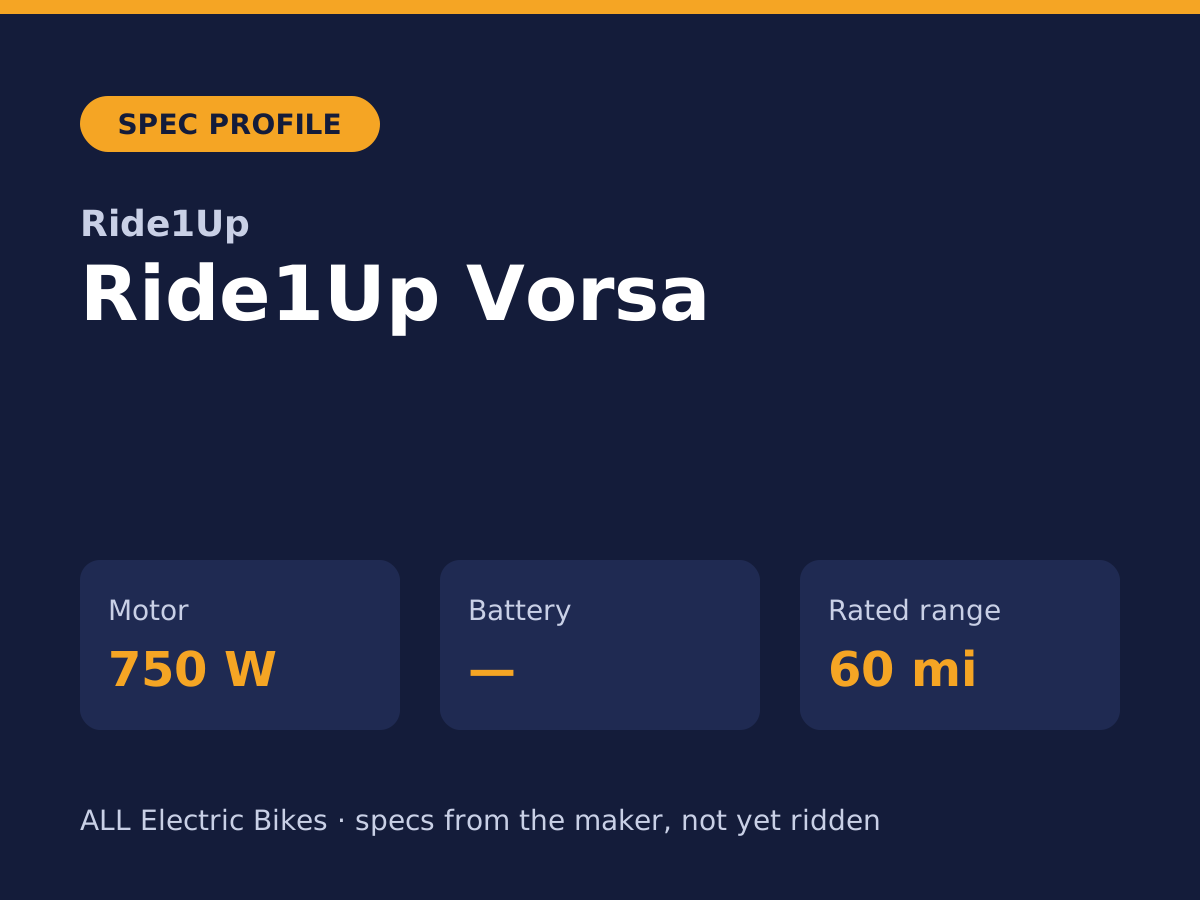
Ride1Up pitches the Vorsa as an SUV-style e-bike. On paper it’s a utility bike with a big payload: 440 lb total, a 150 lb rated passenger-capable rear rack, trailer hitch compatibility and a 750W hub motor that Ride1Up rates at 95Nm of torque, its strongest hill-climbing motor. It also lists both a torque sensor and a cadence sensor, so you can choose how the assist feels.
If you want one bike that can haul groceries, a child seat or a trailer, the numbers are aimed at you. At 65 lb without add-ons, it’s not a bike you’ll want to lift often.
Price: from $1,395 on ride1up.com as of Oct 23, 2026. Ride1Up sells three versions (Vorsa, Vorsa Lite and Vorsa FT), and the price varies by version and add-ons.
Quick specs
These come from Ride1Up’s Vorsa page, checked Oct 23, 2026. Rows are for the standard Vorsa unless noted.
| Spec | Vorsa |
|---|---|
| Motor (W) | 750 |
| Torque (Nm) | 95 |
| Battery (Ah) | 15 |
| Controller (V) | 48 |
| Rated range (mi) | 30-60 |
| Top speed, Class 3 setting (mph) | 28 |
| Fork travel (mm) | 100 |
| Front rotor (mm) | 180 |
| Rear rotor (mm) | 203 |
| Tires (in) | 27.5 x 2.6 |
| Gears | 8 |
| Rear rack rating (lb) | 150 |
| Payload (lb) | 440 |
| Weight without add-ons (lb) | 65 |
| Weight with add-ons (lb) | 70 |
| Starting price (USD, Oct 23, 2026) | 1,395 |
Sources: Ride1Up Vorsa spec page. The battery voltage isn’t stated on the battery line, so I’ve left out a Wh figure rather than guess. The Vorsa Lite uses 27.5 x 2.2 in tires and the Vorsa FT uses 26 x 4 in fat tires, per Ride1Up.
What the specs mean on the road
750W hub, 95Nm. Torque is the twisting force that gets you moving from a stop and up a hill. 95Nm is high for a rear hub motor. The bikes I’ve tested in this class mostly list 60 to 80Nm, or don’t list torque at all. More torque matters most when the bike is loaded.
Torque plus cadence sensor. A torque sensor scales motor power to how hard you push, which usually feels natural. A cadence sensor turns the motor on when the cranks spin, regardless of effort. Having both lets you pick: torque mode for a bike-like feel, cadence mode when you want the motor to do more of the work.
440 lb payload, 150 lb rack. Payload is rider plus everything else. A 200 lb rider leaves 240 lb for passengers and cargo, but the rack itself is rated for 150 lb. Stay within both numbers. Ride1Up calls the rack passenger-capable, so a child on a proper seat fits inside the rating.
Hydraulic discs, 203mm rear and 180mm front. Bigger rotors give the pads more leverage and shed heat better. A larger rear rotor makes sense on a bike built to carry weight over the back wheel.
100mm coil fork with hydraulic lockout. The fork takes the edge off potholes and rough paths. The lockout firms it up on smooth roads.
27.5 x 2.6 in tires. Ride1Up lists Schwalbe Smart Sam or Continental Ruban Touring tires, depending on frame style. Bigger wheels roll over bumps more easily than 20 inch cargo wheels, and 2.6 inch is a wide, cushioned all-road size. The trade-off is a higher rack and load height than small-wheel cargo bikes.
65 to 70 lb. That’s heavy to lift onto a car rack or carry up stairs, and typical for a cargo-capable e-bike.
How it compares to bikes I’ve tested
- Aventon Abound: 750W sustained, about 720Wh, a 440 lb payload and a 143 lb rear rack on 20 inch wheels. The payload is the same on paper. The Vorsa lists a slightly higher rack rating and bigger wheels; the Abound’s small wheels keep the load lower.
- Rad RadRunner 3 Plus: 750W, 672Wh, 350 lb payload, a 120 lb rack and 75.5 lb per Rad, on 20 x 3.3 in tires with a cadence sensor. The Vorsa lists more payload and rack capacity at less weight, plus a torque sensor option.
- Rad RadWagon 4: a true longtail cargo bike. If you need to carry two kids, a longtail is still the purpose-built choice. The Vorsa is closer to a big commuter that can carry one passenger.
These comparisons use published numbers. They aren’t ride impressions of the Vorsa.
Who it’s for
- Riders who want one bike for commuting and hauling
- Parents carrying one child on a rack-mounted seat
- Riders who want to tow a trailer
- Hilly areas, where the 95Nm rating matters
Who should skip it
- Anyone who needs to lift the bike often: it’s 65 lb without add-ons
- Families carrying two kids, who are better served by a longtail
- Riders who want a light, simple commuter
Price and where to buy
As of Oct 23, 2026, Ride1Up lists the Vorsa from $1,395 on its own site. The price changes with the version (Vorsa, Lite or FT) and add-ons, so confirm the version before you compare. I don’t have an affiliate link for Ride1Up.