ALL Electric
In the full review (20 sections)
- Should you buy one?
- Quick specs
- Pros and cons
- Motor, battery and pedal assist
- Two displays
- Assembly and accessories
- Lights
- Cargo and passengers
- Brakes, fork and tires
- The frame and the saddle
- The battery, crankset and slap guard
- Weather and kickstand
- Storage: SteadyRack
- What the specs mean on the road
- How it compares
- Who it’s for
- Who should look elsewhere
- FAQ
- Price
- Related reviews and guides
Should you buy one?
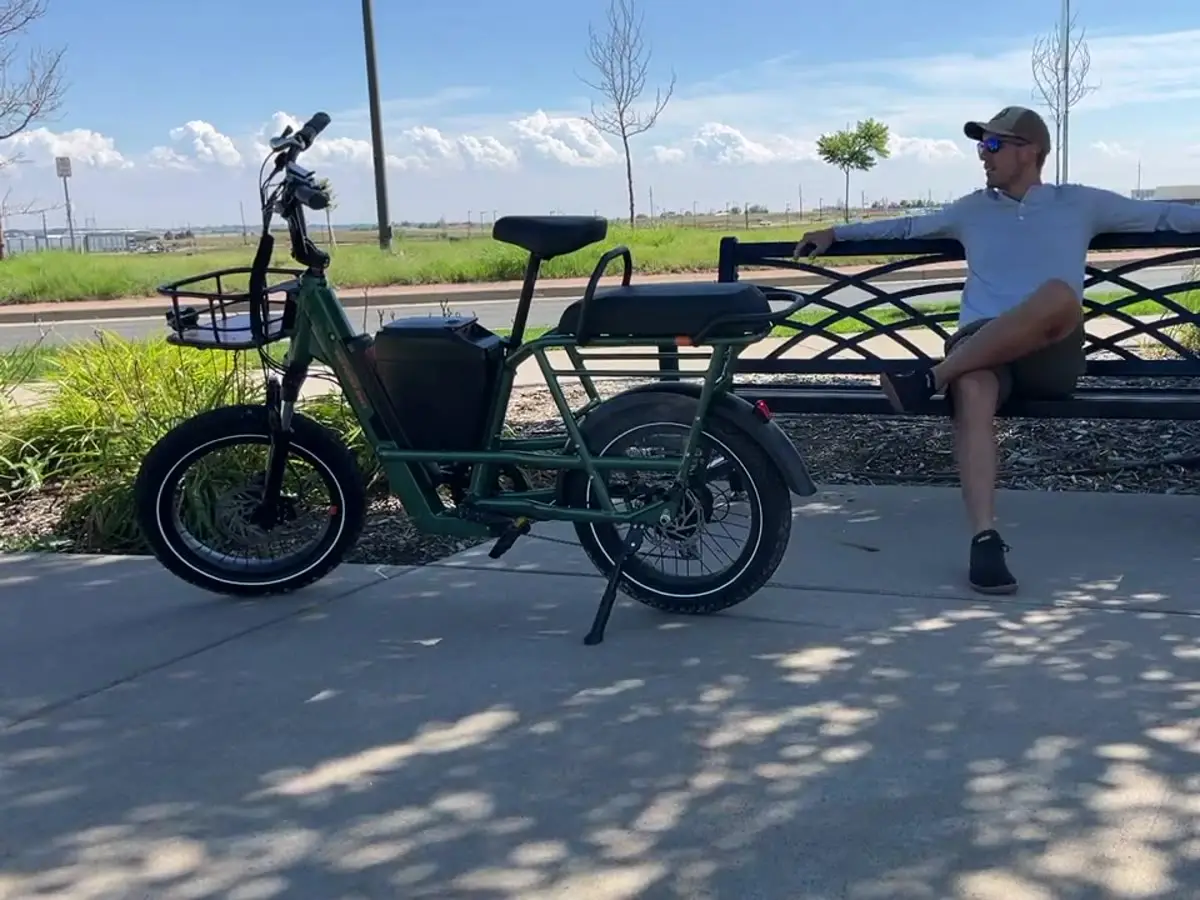
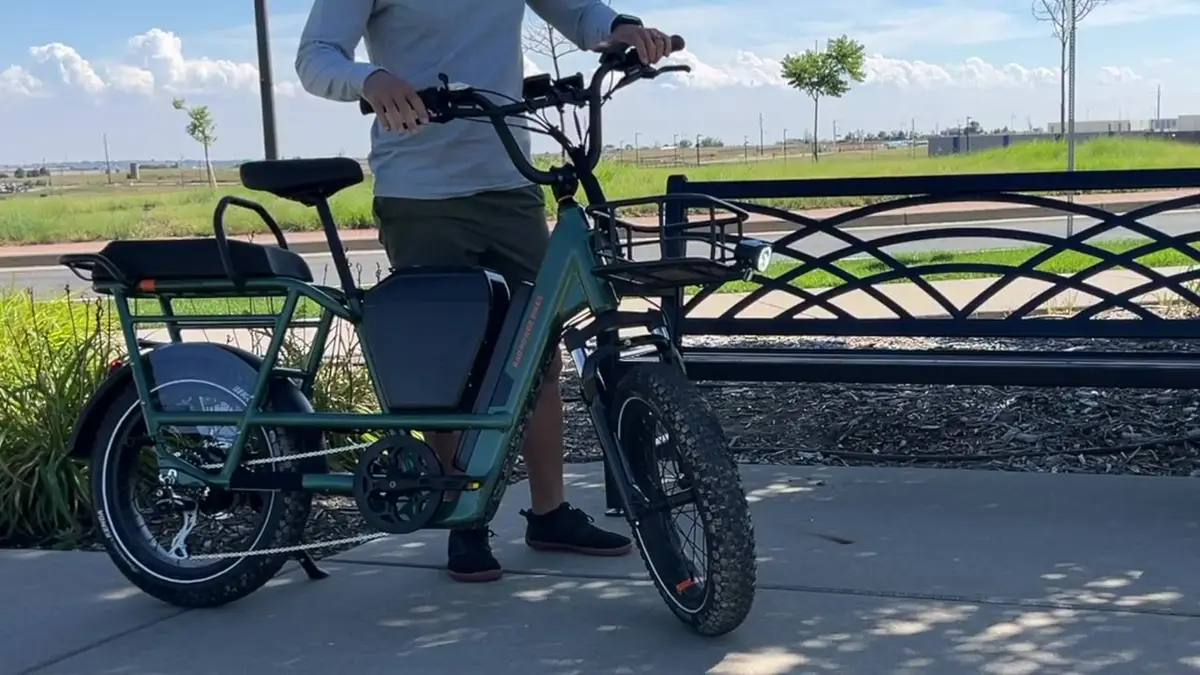
If you’ll ride it to work five days a week, or you’re replacing a car, the RadRunner 3 Plus is worth it. If you won’t ride it that often, don’t buy it new. I tested this utility e-bike for several weeks with the passenger package, the center console and the front rack. It carried my kids, hauled backpacks and handled mud and gravel well.
What I’d change: the saddle is too flat, the battery is only “semi-integrated” and it uses a cadence sensor. At this price I’d like to see a torque sensor.
Buying note: as of Oct 22, 2026, the RadRunner 3 Plus product page on Rad Power Bikes’ site returns a “page not found” error, so I couldn’t confirm a current price or whether it’s still sold new. If it’s gone, used is the way to go. That’s what I’d suggest for occasional riders anyway.
Check the RadRunner 3 Plus (affiliate link)
Quick specs
These come from Rad Power Bikes’ RadRunner 3 Plus product page as saved by a search engine, because the live page returned a “page not found” error on Oct 22, 2026. The magnet count and price rows are from my September 2023 video.
| Spec | Rad RadRunner 3 Plus |
|---|---|
| Motor (W) | 750 |
| Battery (V) | 48 |
| Battery (Ah) | 14 |
| Battery (Wh) | 672 |
| Rated range (mi) | 25-45 |
| Top speed (mph) | 20 |
| Pedal assist levels | 5 |
| Cadence sensor magnets | 12 |
| Rear gears | 7 |
| Fork travel (mm) | 60 |
| Brake rotors (mm) | 180 |
| Tires (in) | 20 x 3.3 |
| Rear rack capacity (lbs) | 120 |
| Total payload (lbs) | 350 |
| Max rider weight (lbs) | 265 |
| Weight (lbs) | 75.5 |
| Charger (A) | 2 |
| Price as tested with accessories, Sep 2023 (USD) | 2,800 |
Where the numbers are shaky:
- Price. I said the bike was $2,500 plus depending on accessories, and just over $2,800 as I tested it. With no live product page, I can’t give a current price.
- Range. Rad rated it 25 to 45 plus miles. I quoted up to 45 miles. Your range depends on rider weight, cargo, passengers and how much you use the throttle.
- Kickstand. My green bike had a side kickstand. Rad’s page said the other colors came with a center kickstand.
- Rules. It’s a 20 mph bike, but e-bike rules vary by state, so check your state’s e-bike laws.
Pros and cons
Pros
- 750W hub motor and a 672Wh battery
- Integrated rear rack rated for 120 lbs; in my video I said it can easily carry a full-size adult
- Passenger package with foot pegs, foot guards and handles for kids
- Lockable center console storage that’s huge
- Front rack with a headlight extension
- Auto-on headlight and tail light that doubles as a brake light
- Hydraulic disc brakes
- RST spring fork with 60mm of travel, preload and lockout
- Knobby, puncture-resistant 20 inch tires that did well in mud and gravel
- Water-resistant connectors and wiring
- Easy assembly
Cons
- Cadence sensor, not a torque sensor, at this price
- Flat saddle that lets you slide around
- “Semi-integrated” battery
- Basic crankset
- Kickstand can’t be trusted with a passenger climbing on
- Expensive once you add accessories
- No live product page or current price as of Oct 22, 2026
Motor, battery and pedal assist
The RadRunner 3 Plus has a 750W brushless hub motor and a 672Wh battery. I quoted a range of up to 45 miles per charge, which makes it a good daily commuter.
You get five levels of pedal assist from a cadence sensor with 12 magnets. I’d like a torque sensor at this price. If you want more exercise, turn the motor off or leave it at level one. If you don’t feel like doing anything, just twist the throttle.
Two displays
This is Rad’s newer interface, and you get two displays: one on the left side and one in the center. They’re easy to read and show your speed, the distance you’ve ridden, the battery level and your pedal assist level. When you turn it on, the startup screen spells out RAD, which is kind of cool.
Assembly and accessories
Putting it together is easy. All you really have to do is put on the front tire and the pedals. If you order accessories, which I highly suggest, those you’ll have to install yourself.
Passenger package
The passenger package is my pick. You get clear plastic guards that keep your passenger’s feet out of the wheel. The foot pegs fold up and down and feel really nice and solid.
The passenger handle is nicely integrated. It works great for younger kids riding on the back, since they have something to hold. There’s a handle in front of them and another that wraps around the rear.
Center console
With the step-through frame, I added the center console. It’s like a tank storage box between your legs, and one of the best features I’ve had on an e-bike. It’s huge, it fits your wallet, keys or a water bottle, and it locks, so you can leave things in it while you run into a store. It doesn’t get in the way when I pedal; you just step over it.
Front rack
The front rack is great for throwing a kid’s backpack into. If you order it, it comes with an extension for the headlight, so the headlight sits right on the front of the rack.
Lights
The integrated LED lights turn on automatically, and the tail light doubles as a brake light. You all know I love seeing lights built right into the bike.
Cargo and passengers
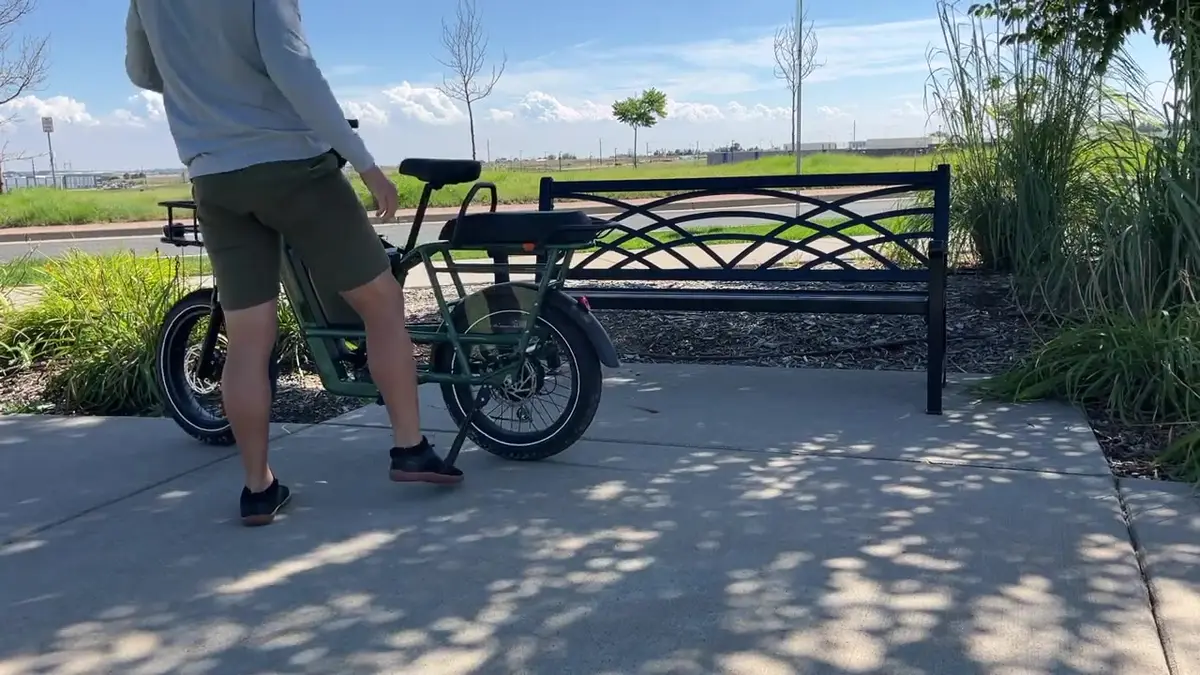
This is where the RadRunner 3 Plus stands out. The rear rack is rated for 120 pounds, but I think that undersells it. The rear rack is part of the frame, so in my video I said you can easily carry a full-size adult on the back (4:24-4:28). Rad still rates the rack for 120 pounds, so stay within that rating and within Rad’s 350 lb total payload. Add up your passenger and cargo before you load it.
Brakes, fork and tires
The brakes are hydraulic discs.
The RST spring fork gives you 60mm of travel, with preload adjustment and a lockout. It makes the bike really nice on gravel, and the knobby tires help too. I’ve taken this bike through mud and gravel, and I was impressed with how it handled.
The tires are 20 inch and puncture resistant. In my video you can see mud spraying up, since I took the front fender off.
The frame and the saddle
The saddle is my biggest complaint. It’s the flattest seat I’ve ever ridden on an e-bike. There’s plenty of cushion, but it’s so flat it almost feels like sitting on squishy cardboard. My butt wants to wiggle around. Most bike seats have some curve that keeps you in place. I’d love to see an upgraded seat on the next version. If you buy one and don’t like the seat, you can find an upgrade on Amazon.
The battery, crankset and slap guard
Rad calls this a “semi-integrated” battery. I feel like a battery is either integrated or it’s not. It looks pretty decent, but if you’re going to integrate the battery, integrate it.
The crankset is nothing to write home about. I do like that Rad added a slap guard on the frame to keep it from scratching the paint. The green on my test bike looks great.
Weather and kickstand
The RadRunner 3 Plus has water-resistant connectors and wiring harnesses, and Rad says you can ride it in the rain.
My bike had a side-mounted adjustable kickstand. If a kid or an adult is climbing on the back, make sure the rider is holding the bike. Don’t rely on the kickstand to hold it up. It can tip over, especially with a little kid climbing on.
Storage: SteadyRack
I store all my e-bikes on SteadyRack wall racks, and they’re awesome. For the RadRunner 3 Plus you need the fat tire version, which doesn’t work with front fenders. That’s why I didn’t have the front fender on. Two racks cost $179 when I made my video, which is rather expensive. They swivel, they’re solid and they’re easy to install. I staggered mine about six inches apart, each on a stud, and it keeps my garage from being a complete disaster.
SteadyRack on Amazon (affiliate link)
What the specs mean on the road
672Wh battery, 25-45 miles. Rad’s range spreads wide because cargo matters. The 45 miles is the best case: a light load and low assist. Add a kid on the back and use the throttle, and expect the low end.
Cadence sensor, 12 magnets. The motor switches on once the cranks turn. It doesn’t measure how hard you push. That’s why I’d like a torque sensor at this price.
350 lb payload, 265 lb max rider. These are separate limits. A 200 lb rider leaves 150 lbs for a passenger plus everything in the console and racks. Check that before putting an adult on the back.
75.5 lbs. That’s heavy to lift onto a car rack or carry up steps.
Hydraulic discs, 180mm rotors. Rad lists both.
60mm RST spring fork. It’s short travel, enough to take the edge off gravel. The lockout stiffens it for smooth pavement.
20 x 3.3 tires. They did well for me in mud and gravel.
2A charger. Plan on charging overnight.
How it compares
| RadRunner 3 Plus | Rad RadWagon 4 | Mod Easy SideCar 3 | |
|---|---|---|---|
| Motor (W) | 750 | 750 | 750 |
| Battery (Wh) | 672 | 672 | 720 |
| Rated range (mi) | 45 | 45 | Not listed |
| Total payload (lbs) | 350 | 350 | 400 |
| Rear rack capacity (lbs) | 120 | 120 | Not listed |
| Weight (lbs) | 75.5 | 76.7 | Not listed |
| Wheel diameter (in) | 20 | 22 | 24 |
| Rear gears | 7 | 7 | Not listed |
| Front suspension | Yes | No | Not listed |
Source note: RadRunner figures are from Rad’s saved product page. RadWagon 4 figures are from my RadWagon 4 review. Mod Easy figures are from my Mod Easy SideCar review. Range figures are each brand’s top rated number.
The RadRunner is shorter and has a front fork; the RadWagon is the longtail if you need more room on the back. The Mod Easy takes a different approach, with a sidecar for your passenger. For more options, see my best cargo e-bike guide.
Who it’s for
- Riders replacing a car or commuting five days a week
- Parents who want to carry kids on the back
- Anyone who runs errands and needs front and rear storage
- Riders who go on gravel and some mud
- Riders who want a step-through frame
Who should look elsewhere
- Occasional riders. Buy a used one on Facebook Marketplace instead.
- Riders who want a torque sensor
- Anyone who wants a fully integrated battery
- Riders who want a basic e-bike without the utility price
FAQ
Can the RadRunner 3 Plus carry an adult?
In my video I said that because the rack is part of the frame, you can easily carry a full-size adult. Rad rates the rear rack for 120 pounds, though, so stay within that rating and the 350 lb total payload.
How far can it go?
I quoted up to 45 miles per charge from the 672Wh battery. Rad rated it 25 to 45 plus miles.
Does it have a torque sensor?
No. It uses a cadence sensor with 12 magnets and five levels of pedal assist.
Does it have suspension?
It has an RST spring fork with 60mm of travel, preload adjustment and a lockout.
Can you ride it in the rain?
Rad says you can. It has water-resistant connectors and wiring harnesses.
Price
As of Oct 22, 2026, Rad Power Bikes’ RadRunner 3 Plus page isn’t live, so there’s no current price I can confirm. When I tested it, the bike with all accessories came to just over $2,800. I thought that was a pretty good price for what you get, if you’ll actually ride it a lot.
Check the RadRunner 3 Plus (affiliate link)