 ALL Electric
In this guide (9 sections)
I’m about 6’1” and around 200 pounds, and I’ve ridden every bike on this site at that weight. That’s not heavy by the standards of a lot of people who email me, but it’s heavy enough that I notice when a motor runs out of breath on a hill, when a seat goes flat after ten miles, or when a kickstand starts to look nervous with a kid climbing on the back.
If you weigh 250, 300 or more, the most important number on a spec sheet isn’t the motor watts or the range. It’s the maximum load, sometimes called payload or max weight capacity. This guide shows you how to read that number, how to do the math for your own body plus everything you carry, and which bikes I’ve tested list the highest capacity. I’ll also tell you where my own riding backs that up and where it doesn’t.
The short answer
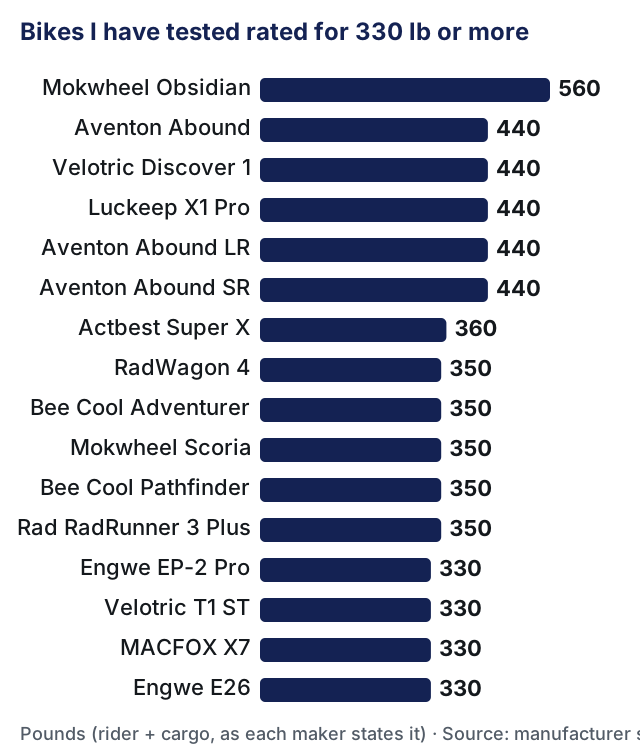
If you just want the bikes, here are the ones I’ve tested with the highest maker-listed load, and what I actually saw on them:
| Bike | Max load (maker) | Motor | Brakes | Bike weight | What I saw |
|---|---|---|---|---|---|
| Mokwheel Obsidian | 560 lb | 750W rated, 105 Nm | Hydraulic disc | About 77 lb | Plenty of power on and off road; dual suspension |
| Aventon Abound LR | 440 lb total, rack 143 lb | 750W, 80 Nm, torque sensor | Hydraulic disc | 88 lb | I sat on the back at about 200 lb and felt sturdy |
| Aventon Abound SR | 440 lb total, rack 143 lb | 750W | Hydraulic disc | 80 lb | Carried my kids for weeks; very stable kickstand |
| Aventon Abound | 440 lb total, rack 143 lb | 750W | Not listed | Not listed | Smooth, steady power even hauling |
| Velotric Discover 1 | 440 lb | 500W, 65 Nm | Hydraulic disc, 180 mm | About 63.5 lb | Fit me and my wife; responsive throttle |
| Luckeep X1 Pro | 440 lb | 750W, 80 Nm | 180 mm disc | 81 lb (another Luckeep page says 70) | Plenty of power for me on steep inclines |
| Bee Cool Adventurer | 350 lb, rack 60 lb | 750W, 92 Nm | 180 mm rotors | 78 lb | 32 mi on throttle at 200 lb, but I bottomed out the fork |
| Bee Cool Pathfinder | 350 lb | 750W, 92 Nm | 180 mm disc | Not listed | Brakes stopped me hard from about 20 mph |
| Mokwheel Scoria | 350 lb | 750W, 90 Nm | Hydraulic disc | 79 lb | Weeks on dirt and gravel with no trouble |
| RadWagon 4 | 350 lb total, rack 120 lb | 750W | Not listed | About 77 lb | Stable with a full load of kids |
All load, motor and weight numbers are the maker’s. The last column is from my own testing. “Not listed” means I couldn’t confirm it on the maker’s page, so I left it blank instead of guessing.
What “max load” actually means
Max load is the most weight the maker says the bike is built to carry. On almost every bike I’ve tested, that’s everything on the bike except the bike itself: you, your clothes, your backpack, a kid on the back, groceries in the basket, a child seat, a lock. It’s not just your body weight.
A few things make this number tricky:
- Some makers split it. Aventon lists the Abound LR and SR at 440 lb total, with the rear rack rated for 143 lb of that. Rad lists the RadWagon 4 at 350 lb total with 120 lb on the rack. The RadRunner 3 Plus is listed at 350 lb total payload, with a 265 lb rider limit and 120 lb on the rack. So you can be under the total and still be over one part.
- Some list a rider limit only. The Ziprs F1 listed a 260 lb rider. That doesn’t tell you how much cargo you can add on top.
- Some pages disagree with themselves. Luckeep’s own pages for the X1 Pro don’t agree on weight or battery size, and the Engwe EP-2 Pro page had conflicting motor numbers. When that happens I show you both and tell you which one I’d trust less.
When the spec says “Max load,” I treat it as rider plus everything you carry. If the brand says otherwise, believe the brand.
Do the math for your own ride
Here’s the quick way to check a bike before you buy it. Add up every pound that will be on it during a normal ride, then compare that to the max load. I like to keep at least 10 percent in reserve, because you’ll eventually carry more than you planned.
Example 1: a 260 lb commuter.
- Rider: 260 lb
- Clothes, shoes, helmet: about 8 lb
- Backpack with a laptop and lunch: about 12 lb
- Lock: about 5 lb
- Total: 285 lb
A bike listed at 300 lb, like the Aventon Level 3, leaves you just 15 lb of room, about 5 percent. That’s under my 10 percent buffer, and one grocery stop on the way home puts you over. A 330 lb bike like the Velotric T1 ST leaves 45 lb. A 440 lb bike like the Velotric Discover 1 leaves 155 lb, which is plenty of room for a rear rack and bags later.
Example 2: a 230 lb parent hauling a kid.
- Rider: 230 lb
- Child: 45 lb
- Bags and snacks: 15 lb
- Total: 290 lb, with 45 lb of it on the rear rack
On a cargo bike like the Abound SR, the total is well under 440 lb and the rack load is well under 143 lb. On a regular commuter rated at 300 lb, the total technically fits, but the rear rack on the Level 3 is rated for about 60 lb. A child seat plus a growing kid will run out of rack long before the bike runs out of total capacity.
Example 3: a 300 lb rider who wants to ride trails.
- Rider: 300 lb
- Gear, water, tools: 15 lb
- Total: 315 lb
This rules out a lot of bikes on paper. Of the fat tire bikes I’ve tested, the Bee Cool Adventurer, Pathfinder and Scoria are listed at 350 lb, which is about an 11 percent buffer. The Obsidian is listed at 560 lb, which is the most of anything I’ve tested, and it’s the one I’d look at first for this rider. More on that below.
Why load matters more than you’d think
The number isn’t just a legal disclaimer. Extra weight shows up in five places:
- Brakes. More mass means more energy to turn into heat every time you stop. Hydraulic disc brakes with larger rotors handle that better than mechanical discs or rim brakes. Every bike near the top of my load chart, except the Bee Cool bikes, lists hydraulic brakes, and the Bee Cool bikes use 180 mm rotors.
- Wheels and spokes. Most failures I hear about on overloaded bikes are broken spokes or bent rims, especially on the rear wheel where most of your weight sits.
- Tires. Wider tires at the right pressure spread the load and protect the rim. That’s one reason fat tire and cargo bikes tend to carry more.
- Motor and battery. The motor has to work harder, which pulls more current and drains the battery faster. On my test of the Bee Cool Adventurer I got 32 miles on throttle only at 200 lb on a route that wasn’t flat. Bee Cool rates it for about 50 miles on throttle.
- Suspension. A fork or shock tuned for a 170 lb rider can bottom out under a heavier one. I bottomed out the Adventurer’s front fork on rooty trails at 200 lb.
Motor: why torque helps more than watts
When you’re heavier, the motor matters most at the moments when you’re going slowly: starting from a stop and climbing. That’s where torque shows up. Watts tell you how much power the motor can deliver over time. Torque, in newton-meters (Nm), tells you how hard it can twist the wheel at low speed.
Of the high-capacity bikes in my table, the Obsidian lists 105 Nm, the Bee Cool Adventurer and Pathfinder 92 Nm, the Scoria 90 Nm, the Abound LR and Luckeep X1 Pro 80 Nm, and the Discover 1 65 Nm. My guide to hills and torque goes into what those numbers feel like.
What I saw at 200 lb lines up with that. The 750W bikes all got me up the hills I tried. The small motors were a different story:
- The Eahora XC100’s 350W motor stalled on hills on throttle alone, and Eahora lists its load at just 187 lb.
- On the ONEBOT S7, with a 250W motor, I was pedaling on any incline.
- On the MACFOX X7 I wanted more power on inclines. I said it was right for a 150 to 185 lb teen, not for me.
- On the Hiland Sabo 2.0, the 350W motor helped on hills, but I still had to pedal.
The exception is the Ziprs F1. Its 350W motor felt like a 500W motor to me at 200 lb, even on big inclines. But it lists a 260 lb rider limit, so it’s not a heavy-rider bike either way.
If you’re over about 250 lb and you have hills, I’d stick to 750W bikes with a listed torque of 80 Nm or more. That’s a general rule from how these motors work. I can only vouch for how they rode at my weight.
Frame and fit for bigger riders
Load capacity doesn’t help if the bike doesn’t fit. A few things I check:
- Step-through frames make it easier to get on and off when you’re carrying weight. They also let you stand over the bike more easily at a stop. The Abound family, the Discover 1 Step-Through and the Scoria are all step-through.
- Seat height and fixed seats. The Actbest Super X is listed for 330 to 360 lb, but the seat is fixed and can’t be raised or lowered. At 6’1” it was quite uncomfortable to pedal. If you’re tall and heavy, skip any bike where you can’t adjust the seat.
- Kickstands. If you’ll carry a passenger, you need a stand that holds the bike when someone climbs on. The Abound SR’s kickstand was very stable. With the RadWagon 4, I’d still hold the bike while kids get on and off, even with the kickstand down.
- Seats. Wide isn’t the same as comfortable. The Obsidian’s seat is wide but rigid. The Abound LR’s is plush.
My picks by rider
Heaviest riders and off-road: Mokwheel Obsidian
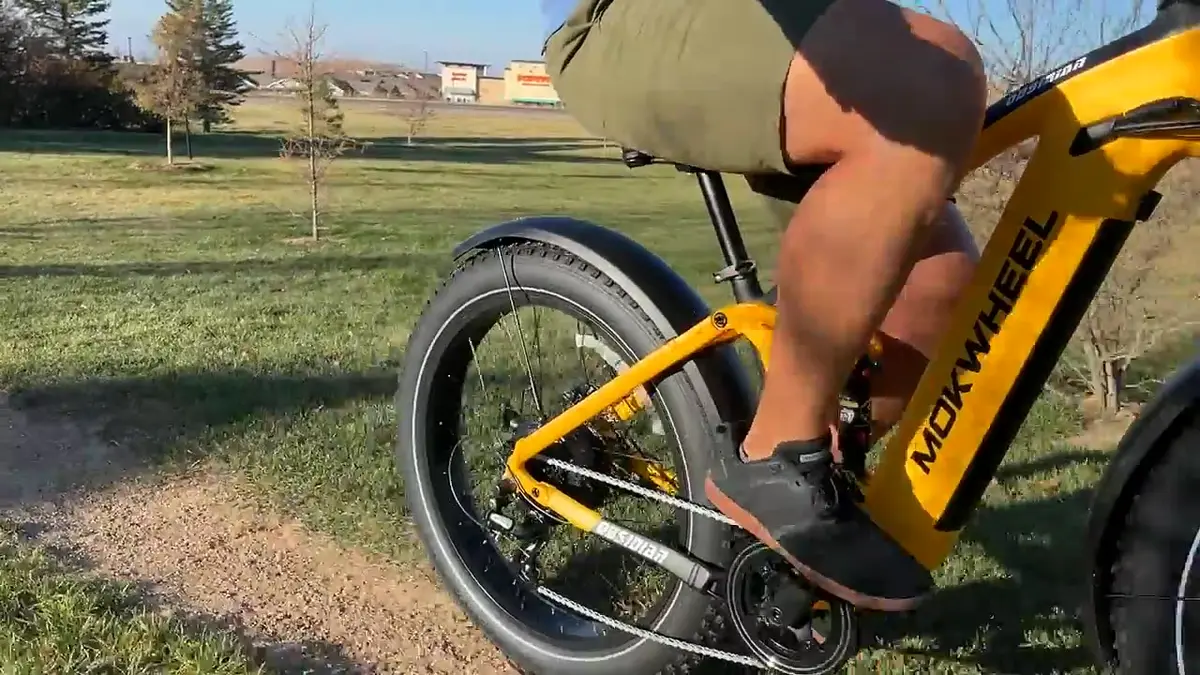
At 560 lb, the Obsidian has the highest listed capacity of any bike I’ve tested by a wide margin. It also lists 105 Nm, dual suspension, Tektro hydraulic disc brakes and 26 x 4.0 fat tires. In my initial review I said the dual suspension makes it really comfortable and the motor has plenty of power on and off road. What to know: there’s no integrated tail light, the display doesn’t connect to your phone, and the seat is wide but on the rigid side. It weighs about 77 lb, so it isn’t easy to lift.
Heavy rider who also carries kids or cargo: Aventon Abound LR
The Abound LR is listed at 440 lb total with a 143 lb rear rack. I’m about 200 lb, I sat on the back of this bike, and it felt sturdy. It has a torque sensor, a 750W motor, hydraulic disc brakes with a 203 mm rear rotor and a kickstand that keeps it steady while you load. The trade-off is weight: 88 lb on Aventon’s page. If you want a shorter bike for one small child, the Abound SR has the same 440 lb rating at 80 lb.
Heavy rider on pavement who wants a normal-feeling bike: Velotric Discover 1
The Discover 1 is listed at 440 lb at about 63.5 lb for the step-through, which is a lot of capacity for a bike that light. It has hydraulic disc brakes with 180 mm rotors and a front fork with lockout. It fit both me and my wife with only a seat adjustment, and the throttle and pedal assist gave lots of power instantly. It’s not an off-road bike, and the rear rack is an extra-cost option. I reviewed it at about $1,300 in 2023, and Velotric now sells the Discover 1 Plus.
Heavy rider on a budget who wants fat tires: Bee Cool Pathfinder or Adventurer
Both Bee Cool bikes are listed at 350 lb with a 750W, 92 Nm motor. I got over 40 miles on the Pathfinder with plenty of battery left, and the brakes stopped me hard from about 20 mph. The Adventurer adds a rear shock; I got 32 miles on throttle at 200 lb, but I bottomed out the front fork on rooty trails. If you’re near the 350 lb line, that fork is the first thing I’d worry about.
Common mistakes
- Comparing only your body weight to the limit. Add your gear. A backpack, lock and helmet add up to 20 to 30 lb fast.
- Ignoring the rack rating. Total capacity doesn’t help if your child seat and kid exceed the rack’s own limit.
- Buying for watts alone. A 1,000W bike with no torque number listed tells you less than a 750W bike that lists 90 Nm.
- Skipping the brakes. At higher weights, I want hydraulic discs. Rim brakes, like on the original Soltera, are fine for a light commuter on flat pavement, not for a heavy rider on hills.
- Trusting rated range. Rated range is usually measured with a lighter rider in a low assist level. Expect less. On the EP-2 Pro I got 23 miles throttle-only at 200 lb against a 75 mile rating.
- Running tires soft. A heavy rider on underinflated tires is the fastest way to get a pinch flat or a dented rim. Check the pressure range printed on the sidewall and stay inside it.
FAQ
What is the best e-bike for a 300 lb rider?
Of the bikes I’ve tested, the Mokwheel Obsidian has the most room, at 560 lb listed. For pavement, the Velotric Discover 1 is listed at 440 lb. For carrying kids or cargo too, look at the Aventon Abound LR, also 440 lb. In every case, add your gear and keep about 10 percent in reserve.
Does max load include the rider?
On every bike I’ve tested, yes. It’s the rider plus everything you carry. A few brands add a separate rider limit or rack limit, so check both.
What happens if I go over the weight limit?
You’re outside what the maker designed and tested for. In practice that usually means faster wear on brakes, tires, spokes and suspension, shorter range, and possibly a voided warranty. Check your warranty terms before you ride over the limit.
Do heavier riders get less range?
Yes. The motor has to deliver more power to move more mass, especially on hills and from stops. At 200 lb I got less than the rated range on most throttle-only tests. See my rated vs. tested range chart in the folding e-bike guide.
Is a fat tire e-bike better for heavy riders?
Often, but not automatically. Wide tires spread the load and help comfort. But the Bee Cool and Mokwheel fat tire bikes are listed at 350 lb, the same as the RadWagon 4 cargo bike, while the Velotric Discover 1, with 26 x 2.5 in tires, is listed at 440 lb. Check the load number, not the tire width.
How do I find the max load on a bike I’m looking at?
Look for “max load,” “payload” or “max weight capacity” on the brand’s spec page or in the manual. If you can’t find it, ask the brand in writing before you buy. Every review on this site lists the number in the specs when I could confirm it.
Check prices for the bikes in this guide
Prices change often, so these links go to the current listing. I only show a price where it's in my review data.
- Mokwheel Obsidian · $1,799.99
- Aventon Abound LR · $1,999
- Aventon Abound SR · $1,899
- Aventon Abound · $2,200
- Bee Cool Adventurer · $1,099
- Rad Power Bikes RadWagon 4 · $1,299
- MACFOX X7 · $1,599
Some of these are affiliate links: I may earn a commission at no extra cost to you. Disclosure